Game Medieval Weapon: Cartoon Military Assets
Visual clarity is the backbone of successful strategy gaming and creative design. When developing interfaces for mobile apps, educational materials, or indie games, realism often competes with readability. This is where a dedicated Game Medieval Weapon. Cartoon Military asset collection becomes an essential tool rather than just a decorative afterthought. These vector sets bridge the gap between historical accuracy and functional iconography, providing creators with stylized armament and protection arsenals that communicate instantly to the user.
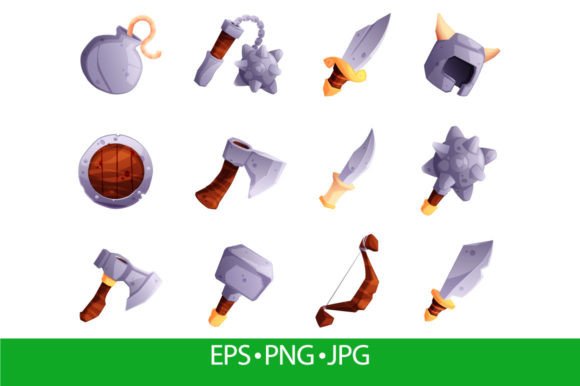
The appeal of cartoon military aesthetics lies in their versatility. Unlike hyper-realistic renders that can become muddy at small sizes or clash with colorful UI elements, stylized vectors maintain their integrity across all resolutions. Whether you are designing a turn-based RPG interface, creating infographics about medieval history, or branding a fantasy-themed business, these assets offer a cohesive visual language. The inclusion of arrows, blades, shields, knives, swords, bombs, and maces covers the fundamental vocabulary of conflict and defense, allowing designers to build comprehensive systems without sourcing disparate elements that lack stylistic unity.
Strategic Applications in Game Development
For game developers and UI designers, consistency is paramount. A common pitfall in indie development is the "asset flip" look, where weapons from different artists clash within the same inventory screen. Utilizing a unified Cartoon military armament and protection arsenal ensures that every item feels like it belongs to the same world. This cohesion extends beyond simple aesthetics; it aids player cognition. When a mace icon shares the same line weight, color palette, and perspective as a shield icon, players process inventory management faster, reducing cognitive load and keeping the focus on gameplay mechanics.
Consider the practical implementation of these icons in different genres:
- Mobile Strategy Games: Small screens demand bold shapes. Cartoon vectors scale down perfectly for unit selection menus and tech trees without losing definition.
- RPG Inventory Systems: Stylized weapons allow for easy categorization. Players can distinguish between slashing, piercing, and blunt damage types through exaggerated shape language rather than intricate detail.
- Achievement and Badge Design: Unlockable content requires distinct silhouettes. A cartoon sword or bomb serves as an immediate visual reward that fits seamlessly into modern achievement pop-ups.
- Loading Screens and Tutorials: Simplified illustrations are ideal for explaining complex mechanics. A stylized arrow pointing at a shield can teach blocking mechanics more effectively than a photorealistic render cluttered with texture noise.
Beyond Gaming: Educational and Commercial Use Cases
The utility of antique medieval illustration styles extends far beyond entertainment software. Educators and content creators frequently struggle to find historical imagery that engages younger audiences or fits modern web layouts without appearing violent or overly graphic. The cartoon military aesthetic softens the subject matter, making it approachable for classroom presentations, museum signage, and history blogs. By abstracting the weaponry, the focus shifts from the brutality of war to the technological and cultural aspects of the era.
Marketers and entrepreneurs also find value in this specific visual niche. Fantasy themes are perennially popular in branding for craft breweries, escape rooms, Renaissance faires, and tabletop gaming communities. However, licensing costs for custom illustrations can be prohibitive for small businesses. High-quality vector sets provide a cost-effective alternative to commission work. Because these assets are typically delivered in EPS, PNG, and JPEG formats, they integrate smoothly into everything from professional print layouts in Adobe Illustrator to quick social media posts created in Canva. The vector format specifically allows for infinite resizing, ensuring that a logo featuring a stylized mace looks crisp on both a business card and a storefront banner.
Adapting Vector Assets for Unique Projects
One of the significant advantages of working with EPS files is the ability to customize. While pre-made sets save time, adding a personal touch prevents your project from looking generic. Designers should view these packs as a foundation rather than a final product. Recoloring is the most immediate adaptation; swapping standard silver and brown tones for neon greens or pastel pinks can instantly recontextualize medieval weaponry for sci-fi or cozy game genres. Modifying line weights can also align the assets with existing brand guidelines, ensuring that imported icons match native typography and UI elements.
Composition offers another avenue for creativity. Individual icons of swords, shields, and bombs can be combined to create new symbols. A crossed sword and quill might represent a lore entry or quest log, while a shield overlaid with a heart could signify health or defense stats. This modular approach maximizes the value of the asset pack. Instead of searching for a specific composite image, you construct exactly what the interface requires. For publishers and freelancers managing multiple client projects, this flexibility reduces the need to purchase separate packs for every minor variation in art direction.
Technical Considerations for Optimal Results
To get the most out of Game Medieval Weapon. Cartoon Military collections, understanding file formats is crucial. Each format serves a distinct purpose in the creative workflow:
- EPS (Encapsulated PostScript): The master source file. Use this for editing, recoloring, and scaling. It preserves vector paths, allowing for non-destructive modifications in software like Illustrator, Affinity Designer, or CorelDRAW.
- PNG (Portable Network Graphics): Essential for digital interfaces. Always export with transparency enabled. PNGs support alpha channels, making them perfect for overlaying weapons onto dynamic backgrounds or UI panels without white boxes.
- JPEG (Joint Photographic Experts Group): Best for reference sheets, mood boards, or print materials where transparency is unnecessary. Avoid using JPEGs for final game assets due to compression artifacts and lack of transparency support.
Organization is equally important when integrating large asset libraries. Establish a naming convention early. Rather than keeping default filenames like "weapon_01.eps," rename files descriptively (e.g., "icon_mace_cartoon_blue.eps"). Create folder structures based on function (Melee, Ranged, Defense) or style variant. This upfront effort saves hours of searching during tight production cycles. For teams, maintaining a shared style guide document that references specific assets ensures everyone uses the correct versions, preserving visual consistency across marketing materials, game builds, and documentation.
Balancing Style with Historical Recognition
While cartoon aesthetics prioritize readability, maintaining enough historical grounding is necessary for audience recognition. A mace must still look like a mace, even if simplified. Effective stylization exaggerates defining features—the flanged head of a mace, the curve of a scimitar, the fletching of an arrow—while removing superfluous texture. When selecting or modifying assets, test them at the smallest intended display size. If the silhouette reads clearly as a specific weapon type at 32x32 pixels, the design is successful. If it becomes an ambiguous blob, further simplification or contrast adjustment is required.
This balance applies to color theory as well. Traditional medieval palettes can sometimes appear dull on backlit screens. Boosting saturation and value slightly helps cartoon military assets pop against dark UI backgrounds common in strategy games. Conversely, for print applications or parchment-style backgrounds, muted earth tones may be more appropriate. Always preview assets in their final context. An icon that looks vibrant in isolation might vibrate unpleasantly against a busy game map or disappear entirely on a textured website header.
Ultimately, the goal is to serve the project's communication needs. Whether you are building a complex strategy game, teaching medieval history, or branding a fantasy product, these illustrated arsenals provide a reliable visual shorthand. They transform abstract concepts of attack, defense, and history into tangible, engaging graphics. By leveraging the scalability of vectors and the universal appeal of cartoon styling, creators can produce professional, cohesive work that resonates with audiences across platforms. The right asset pack does not just fill empty space; it enhances usability, reinforces theme, and accelerates the creative process from concept to final delivery.