Exploring the World of Rocky Flying Island: An Isometric Game Asset Deep Dive
In the ever-evolving world of game development, visual design plays a crucial role in capturing a player's attention and enhancing the overall experience. One such captivating element in modern game design is the Rocky Flying Island isometric asset. Whether you're a seasoned developer or a curious beginner, understanding the significance of isometric game objects like Rocky Flying Island can open up new creative possibilities. In this article, we’ll explore what Rocky Flying Island is, its relevance in isometric game design, and how it contributes to immersive gaming environments.
What Is Rocky Flying Island?
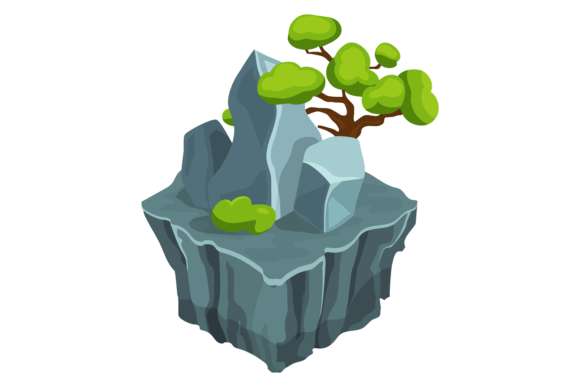
Rocky Flying Island is a stylized, isometric representation of a floating rock formation commonly used in 2D and pseudo-3D game environments. It serves as a ground object or terrain element that can be placed within a game world to add depth, texture, and realism. These assets are typically available in multiple formats such as EPS, JPG, and transparent PNG, allowing for seamless integration into various game engines and design workflows.
As an isometric object, Rocky Flying Island adheres to the isometric projection style, which mimics a 3D perspective while being rendered in 2D. This style is particularly popular in games that require a top-down view with a slight angle, giving the illusion of depth without the complexity of full 3D modeling.
Why Isometric Design Matters in Modern Games
Isometric game design has seen a resurgence in recent years due to its balance between visual appeal and development efficiency. Unlike traditional 2D side-scrolling or fully 3D environments, isometric design offers a unique middle ground that simplifies asset creation while still delivering a rich, immersive experience.
- Efficiency in asset creation: Isometric assets like Rocky Flying Island can be reused across different levels or scenes, reducing the need for multiple variations.
- Visual consistency: These assets maintain a uniform perspective, ensuring that all game elements align seamlessly within the environment.
- Accessibility: The isometric style allows for clear spatial relationships between objects, making it easier for players to navigate and understand the game world.
The Role of Rocky Flying Island in Game Development
Rocky Flying Island is more than just a visual element; it’s a functional part of the game world. Here’s how it contributes to the broader game development process:
1. Enhancing Environmental Storytelling
Game environments tell stories without the need for dialogue. A floating island, for example, might suggest a magical or futuristic world where gravity behaves differently. By incorporating Rocky Flying Island into a scene, developers can subtly communicate the setting’s tone and lore to players.
2. Creating Dynamic Level Design
Isometric levels often rely on layered terrain to create engaging gameplay. Rocky Flying Island can be used as a platform, obstacle, or background detail that adds verticality and complexity to level design. This allows for more creative level layouts and encourages exploration.
3. Supporting Modular Design
One of the key advantages of using isometric assets like Rocky Flying Island is their compatibility with modular design principles. Developers can mix and match different terrain pieces to create varied landscapes without needing to design each element from scratch.
- Combine with other isometric ground objects to build unique terrains.
- Use multiple Rocky Flying Islands to create aerial pathways.
- Layer with foliage, water, or structures for added depth.
Available Formats: EPS, JPG, and Transparent PNG
Rocky Flying Island assets are typically available in three main formats: EPS, JPG, and transparent PNG. Each format serves a specific purpose depending on the project's needs.
EPS (Encapsulated PostScript)
EPS is a vector-based format ideal for scaling without loss of quality. It’s commonly used in graphic design and can be edited in software like Adobe Illustrator. This makes it a great choice for developers who need to customize the asset for different resolutions or game styles.
JPG (Joint Photographic Experts Group)
JPG is a raster format that offers high compression, making it suitable for web-based games or platforms with limited storage. However, it does not support transparency, which can limit its use in layered or complex scenes.
Transparent PNG (Portable Network Graphics)
PNG files with transparency are highly versatile, allowing developers to place Rocky Flying Island over any background without visible edges or borders. This format is ideal for creating clean, professional-looking environments with minimal post-processing.
How Rocky Flying Island Fits into the Bigger Picture
While Rocky Flying Island may seem like a small detail in the grand scheme of game development, its impact is significant. When used effectively, it contributes to the overall atmosphere, gameplay mechanics, and artistic coherence of a game.
1. Aesthetic Cohesion
Games with a consistent visual style tend to be more immersive. Rocky Flying Island helps maintain that cohesion by blending seamlessly with other isometric assets, ensuring that the game world feels unified and intentional.
2. Technical Flexibility
Because isometric assets are relatively simple to implement, they are ideal for indie developers or small studios with limited resources. Rocky Flying Island can be easily integrated into popular game engines like Unity, Godot, or RPG Maker, allowing for quick prototyping and iteration.
3. Creative Inspiration
For artists and designers, having access to well-crafted assets like Rocky Flying Island can spark new ideas. It can serve as a foundation for building entire biomes or inspire new gameplay mechanics based on floating terrain.
Common Misconceptions About Isometric Assets
Despite their popularity, there are a few misconceptions about isometric assets like Rocky Flying Island that are worth addressing:
- Myth: Isometric games are outdated or less advanced than 3D titles.
Reality: Many modern games use isometric design for its efficiency and artistic appeal, not because of technical limitations. - Myth: Isometric assets are easy to create and require little skill.
Reality: Designing high-quality isometric assets involves careful planning, perspective understanding, and attention to detail. - Myth: Rocky Flying Island is just a decorative element.
Reality: It can play a crucial role in gameplay, environment design, and visual storytelling.
Conclusion: Embracing the Power of Isometric Design
Rocky Flying Island is more than just a digital rock floating in a game world — it's a testament to the creativity and innovation that drives modern game development. Whether you're building a fantasy realm, a sci-fi adventure, or a puzzle-based experience, incorporating isometric assets like Rocky Flying Island can elevate your project from good to great.
By understanding the purpose, functionality, and flexibility of isometric game objects, developers and designers can make informed decisions that enhance both the visual and interactive aspects of their games. As the gaming industry continues to evolve, tools and assets like Rocky Flying Island will remain essential for creating engaging, visually stunning worlds that players love to explore.
So next time you're designing a game environment, don’t overlook the power of a well-crafted isometric asset. Whether it’s for aesthetics, gameplay, or storytelling, Rocky Flying Island could be the key to unlocking your next big idea.