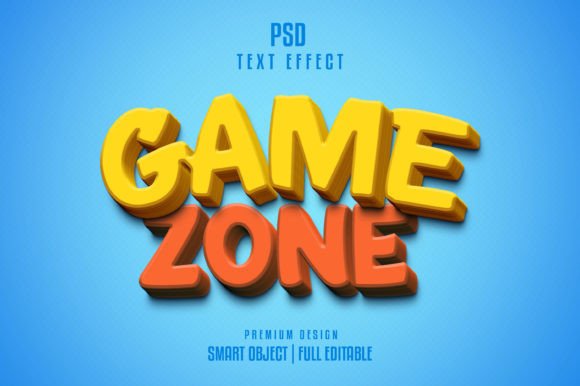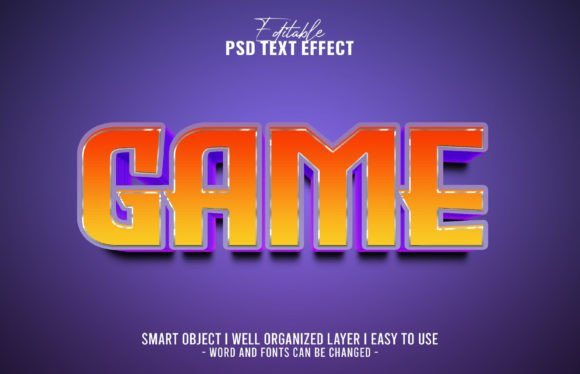
Evaluating the 3D Game Editable Text Effect PSD for Design Projects
In the competitive landscape of digital design, creating high-impact typography often requires a balance between visual complexity and production efficiency. The 3D Game Editable Text Effect PSD serves as a specialized resource designed to bridge this gap. This graphic asset provides designers with a pre-configured Photoshop file that applies a distinct, dimensional aesthetic to text without requiring manual 3D rendering or extensive layer styling from scratch. For professionals and hobbyists evaluating their toolkit, understanding the practical utility, limitations, and appropriate use cases of this specific type of editable effect is essential for making informed workflow decisions.
Understanding the Resource Architecture
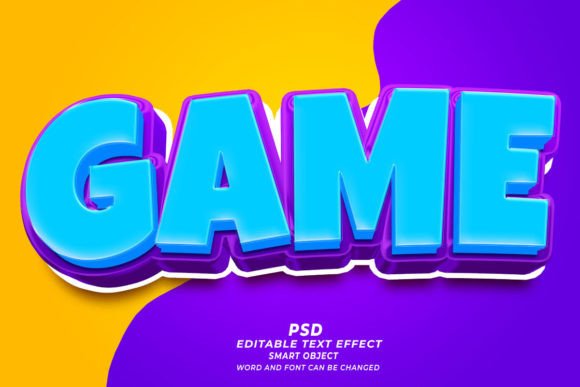
The 3D Game Editable Text Effect PSD is fundamentally a smart object-based template. Unlike standard brush sets or action scripts, this resource relies on the non-destructive capabilities of Adobe Photoshop’s smart object architecture. The core value proposition lies in its automation; the complex lighting, shading, textures, and bevels associated with game-style typography are pre-baked into the layer structure. Users interact with the file by accessing a designated smart object layer, typically labeled "Your Text," where they can input custom copy. Upon saving the smart object, the changes propagate automatically to the main composition, updating all associated effects instantly.
This architecture distinguishes the resource from true 3D software workflows. While the output mimics three-dimensional depth, the underlying data remains two-dimensional pixel information manipulated through layer styles and displacement maps. This distinction is critical for evaluators who must determine whether a raster-based solution meets their technical requirements versus a vector or polygonal alternative.
Primary Benefits for Workflow Efficiency
For designers operating under tight deadlines, the primary advantage of this PSD is speed. Creating authentic 3D game typography manually involves extrusion, material mapping, lighting setup, and rendering—processes that can take hours per iteration. This editable effect reduces that timeline to seconds. The "Very Easy to Edit" feature is not merely a convenience but a significant cost-saving mechanism in commercial environments where multiple variations of headlines or logos are required for A/B testing or localization.
Furthermore, the well-organized layers contribute to maintainability. In poorly constructed templates, effects are often flattened or merged, making color grading or texture adjustments impossible. A high-quality 3D Game Editable Text Effect PSD maintains separation between shadow, highlight, base color, and texture layers. This organization allows designers to adapt the effect to different brand guidelines without breaking the underlying 3D illusion. The high-resolution nature of the file also ensures that the asset remains viable for large-format digital displays or print applications, provided the output dimensions align with the source resolution.
Tradeoffs and Technical Considerations
Despite the efficiency gains, there are inherent tradeoffs to using a pre-made PSD effect. The most significant limitation is resolution dependency. Because the effect is raster-based, scaling the text beyond the original canvas size will result in pixelation and loss of fidelity. Unlike vector-based 3D tools or native Photoshop 3D features (however deprecated), you cannot infinitely scale the output. Evaluators must verify that the base resolution of the PSD exceeds their maximum anticipated output size before acquisition.
Another consideration is typographic flexibility. These effects are often engineered around specific font characteristics, such as bold sans-serifs or blocky display faces. Using thin serifs or script fonts may break the illusion, causing gaps in the extrusion or misaligned highlights. While the text content is 100% editable, the stylistic compatibility is not universal. Designers must assess whether their preferred typeface pairing aligns with the geometric constraints of the effect.
Software version compatibility also warrants attention. Smart objects and advanced layer styles evolve with each Photoshop release. Older versions of Photoshop may not render newer blending modes or smart filters correctly, potentially altering the appearance of the effect. Conversely, users on subscription-free alternatives like Affinity Photo or GIMP may find that proprietary Adobe smart object links do not function as intended, rendering the "easy edit" feature unusable.
Ideal Use Cases and Strategic Fit
The 3D Game Editable Text Effect PSD is strongest when deployed in specific contexts. It is an optimal fit for YouTube thumbnails, Twitch stream overlays, esports tournament branding, and mobile game promotional assets. In these mediums, the visual language demands high contrast and dimensional pop, yet the lifespan of the asset is often short. The speed-to-quality ratio justifies the use of a template over custom modeling.
It is also valuable for mockups and concept presentations. When pitching a game title or a gaming-related product, stakeholders need to visualize the final aesthetic quickly. This resource allows for rapid prototyping of title treatments without committing budget to a dedicated 3D artist during the exploratory phase. If the concept is approved, the team can then decide whether to refine the PSD result or invest in bespoke 3D assets for final production.
When to Consider Alternatives
Evaluators should look beyond this PSD format when scalability or uniqueness is paramount. For major franchise logos or merchandise that will appear across billboards, apparel, and packaging, a vector-based 3D illustration or a dedicated Blender/Cinema 4D render is superior. These alternatives offer infinite resolution and unique lighting scenarios that a static PSD cannot replicate.
Additionally, if the project requires dynamic animation, a PSD is a dead end. While it provides a great still frame, animating the text in After Effects would require separating layers manually, which negates the smart object benefits. In such cases, native 3D text generators within motion graphics software are more appropriate. Finally, if the brand identity requires a subtle, minimalist aesthetic, the inherent boldness of game-style text effects may clash with the design direction, making flat design or subtle embossing techniques better choices.
Making the Final Decision
Selecting the right 3D Game Editable Text Effect PSD requires matching technical specifications with project goals. Before downloading or purchasing, inspect the preview files for layer organization and check the documentation for font recommendations and software requirements. Test the smart object workflow immediately upon acquisition to ensure compatibility with your current Photoshop version.
Ultimately, this resource should be viewed as a productivity accelerator rather than a complete creative solution. It excels at removing technical friction for specific visual styles but requires the designer to understand its boundaries. By weighing the benefits of rapid iteration against the constraints of raster resolution and stylistic rigidity, designers can effectively integrate this tool into a broader, versatile production pipeline. When used judiciously, it transforms complex 3D aesthetics from a bottleneck into a streamlined component of the design process.